Industry 4.0 for PLM Engineers is the fourth industrial revolution — where industries move from manual and disconnected systems to smart, connected, and data-driven environments.
What is Industry 4.0 for PLM Engineers?
Industry 4.0 for PLM Engineers is the transformation of traditional industry into a digital, connected, and intelligent environment. It is not only about using software. It is about how data flows, how systems talk to each other, and how decisions become faster and smarter.
Evolution of industry
| Phase | What changed |
|---|---|
| Industry 1.0 | Steam engines and mechanization |
| Industry 2.0 | Electricity and mass production |
| Industry 3.0 | Computers and automation |
| Industry 4.0 for PLM Engineers | Connected data, smart systems, and digital intelligence |
Why Industry 4.0 for PLM Engineers is needed
Traditional industries face major problems:
- Scattered data across Excel, emails, and documents
- Wrong versions used in engineering or manufacturing
- Slow decision-making and poor traceability
- High rework cost when changes are not controlled
Modern products are more complex, more connected, and faster changing. Traditional methods cannot handle this complexity at scale.
Core pillars of Industry 4.0 for PLM Engineers
Digital Twin
A virtual representation of a real product used for simulation, validation, and optimization.
Connected Data
Machines, systems, sensors, and lifecycle information all work together instead of staying isolated.
Automation
Processes become faster, repeatable, and less dependent on manual coordination.
What does connected data really mean?
Imagine a machine sending temperature data in real time. The system can detect abnormal behavior and warn the company before a failure happens. This is where IoT, analytics, and digital systems work together.
Where PLM and Teamcenter fit in
This is the most important point: Industry 4.0 for PLM Engineers cannot work without structured product data.
PLM systems like Teamcenter manage product structure, BOM, revisions, workflow, supplier collaboration, lifecycle state, and traceability. That makes PLM the digital backbone behind smart industry.
Digital Thread concept
PLM creates a digital thread across the entire lifecycle:
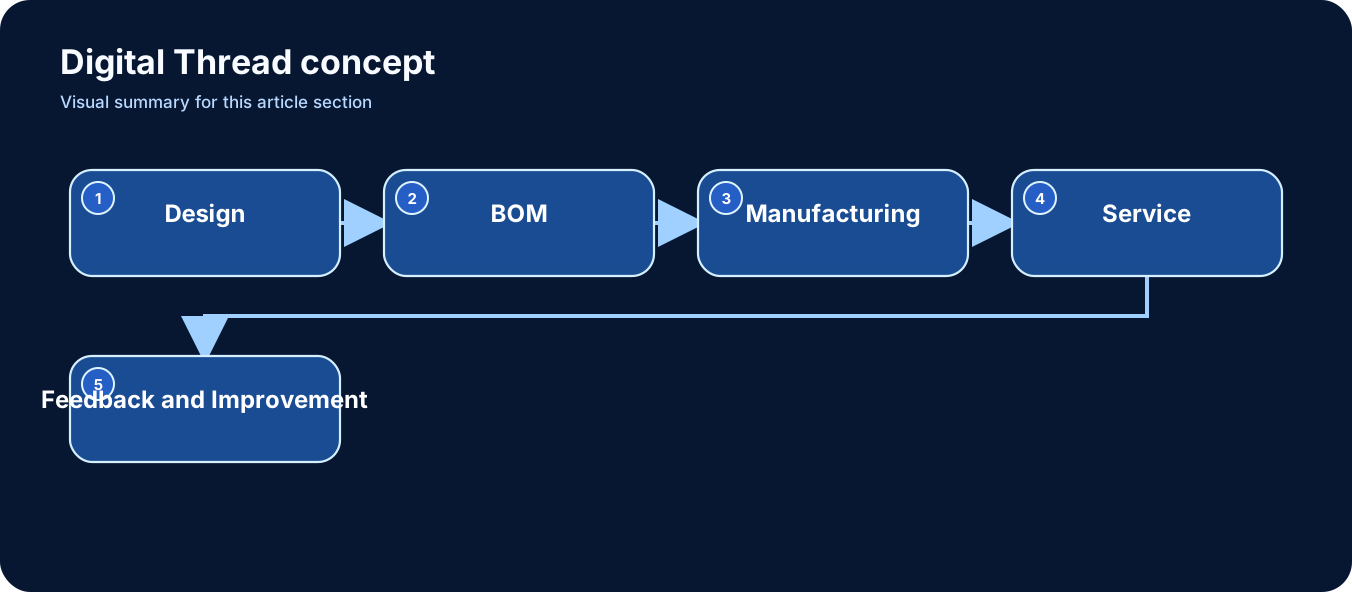
This means one connected source of truth from engineering through operations.
Why traditional industry will not survive
Industries that do not digitalize will face slower innovation, higher cost, more errors, and poor traceability. Meanwhile, digital competitors will move faster with better quality and better lifecycle control.
Simple real example
Think about an aircraft engine.
- Without Industry 4.0 for PLM Engineers: design team uses an old version, manufacturing builds the wrong part, and service team has no history.
- With Industry 4.0 for PLM Engineers + PLM: correct version is always available, changes are traceable, and service teams can see real lifecycle history.
Why this is impactful for beginners
If you are a college graduate or new learner, think of Industry 4.0 for PLM Engineers as the future working model of real companies. It is not only a buzzword. It is how engineering, manufacturing, data, and software are becoming one connected world.
Key takeaways
- Industry 4.0 for PLM Engineers is the fourth industrial revolution
- It depends on connected systems, real-time data, and smart decision-making
- PLM is the foundation because it manages lifecycle structure and traceability
- Traditional industries must evolve or become uncompetitive
- Data is becoming the most important industrial asset
Final thought
Industry 4.0 for PLM Engineers is not just technology. It is a new way of thinking about industry. Companies that understand this will lead. Others will follow — or disappear.