📘 AI + Teamcenter Series
Why “future-proof” matters now
AI is not removing the need for Teamcenter professionals. But it is changing which skills remain valuable. Repetitive coding, repetitive admin support, and purely tool-based work will shrink in importance. Lifecycle understanding, integration thinking, architecture, and problem-solving will become more valuable.
The old model versus the new model

The old model focused on “how to configure” or “how to code.” The new model focuses on “how the product lifecycle should work,” “how systems should connect,” and “how decisions should be made with data.”
The core skill stack of a future-proof Teamcenter developer
1. Lifecycle understanding
You must understand EBOM, MBOM, As Built, and As Maintained not as words, but as connected lifecycle views with real business meaning.
2. Architecture knowledge
You should know how Teamcenter is structured, where performance issues can appear, how enterprise layers behave, and how data moves through the landscape.
3. Integration mindset
Future value is increasingly at the connection points: Teamcenter with ERP, MES, service, document flows, and cross-domain data exchange. A developer who understands integration is much harder to replace.
4. Data understanding
Teamcenter is not only UI. It is data, relations, ownership, classification, effectivity, revision logic, and structure behavior. Deep data understanding stays valuable even when UI patterns change.
5. Problem solving
Real projects are messy. Requirements are incomplete. Data quality is uneven. Customers describe symptoms instead of root causes. A future-proof engineer knows how to investigate, simplify, and explain.
How to use AI correctly
Use it for faster drafting, code scaffolding, documentation support, brainstorming, and comparison help. But validate everything. The final judgment must remain yours.
Domain knowledge becomes a multiplier
PLM is stronger when combined with domain understanding. Aerospace, automotive, manufacturing, service lifecycle, and regulated industries all have different realities. Domain knowledge plus Teamcenter understanding creates rare value.
Communication becomes a differentiator
Architects and leads are not only strong technically. They explain complex things simply, align people, and help teams make decisions. Communication is not a soft side topic. It is one of the biggest career accelerators in PLM.
Career roadmap
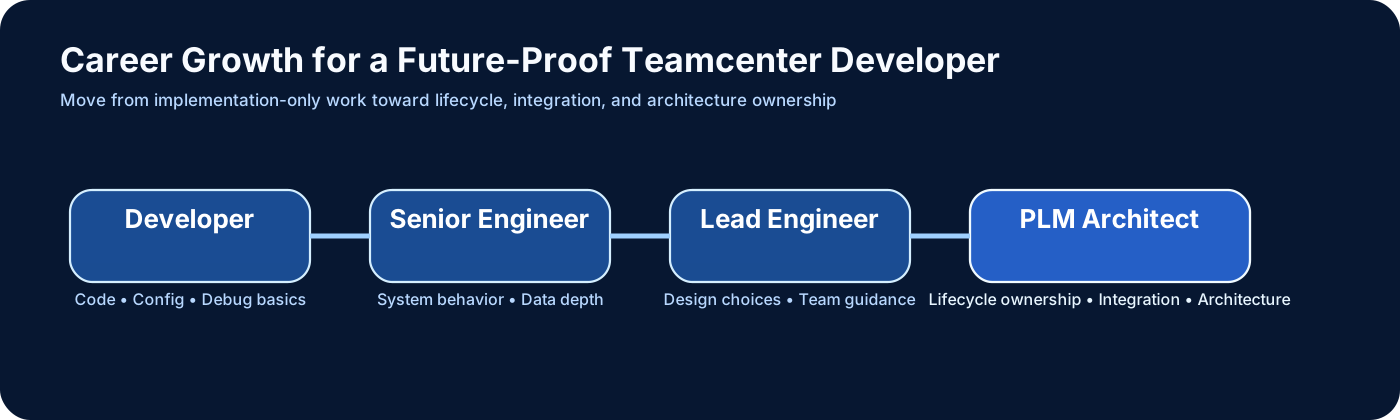
The movement is not from code to no code. The movement is from implementation-only work to lifecycle and architecture thinking.
What will not survive
Profiles built only on copy-paste coding, surface-level configuration, or narrow UI support will struggle more. That work is easier to automate or compress.
What will dominate
People who combine PLM, AI awareness, architecture, integration, and business understanding will lead. They will not just use Teamcenter. They will shape how Teamcenter supports the enterprise.
Final thought
A future-proof Teamcenter developer thinks in systems, not screens. The more you understand lifecycle, ownership, and decision-making, the more valuable you become in the AI era.
👉 Start from the beginning: AI Impact on Teamcenter →
Continue your learning