📘 AI + Teamcenter Series
Why this topic matters
People often talk about AI only from the success side. They say AI will accelerate engineering, automate workflows, and simplify Teamcenter usage. That is partly true. But in real PLM projects, the failures matter just as much as the promises.
AI works best when data is clean, context is clear, and actions are bounded. Real Teamcenter projects are often the opposite. Data is inconsistent, customizations are deep, ownership is unclear, and requirements change while the project is already moving.
AI fails when data is messy
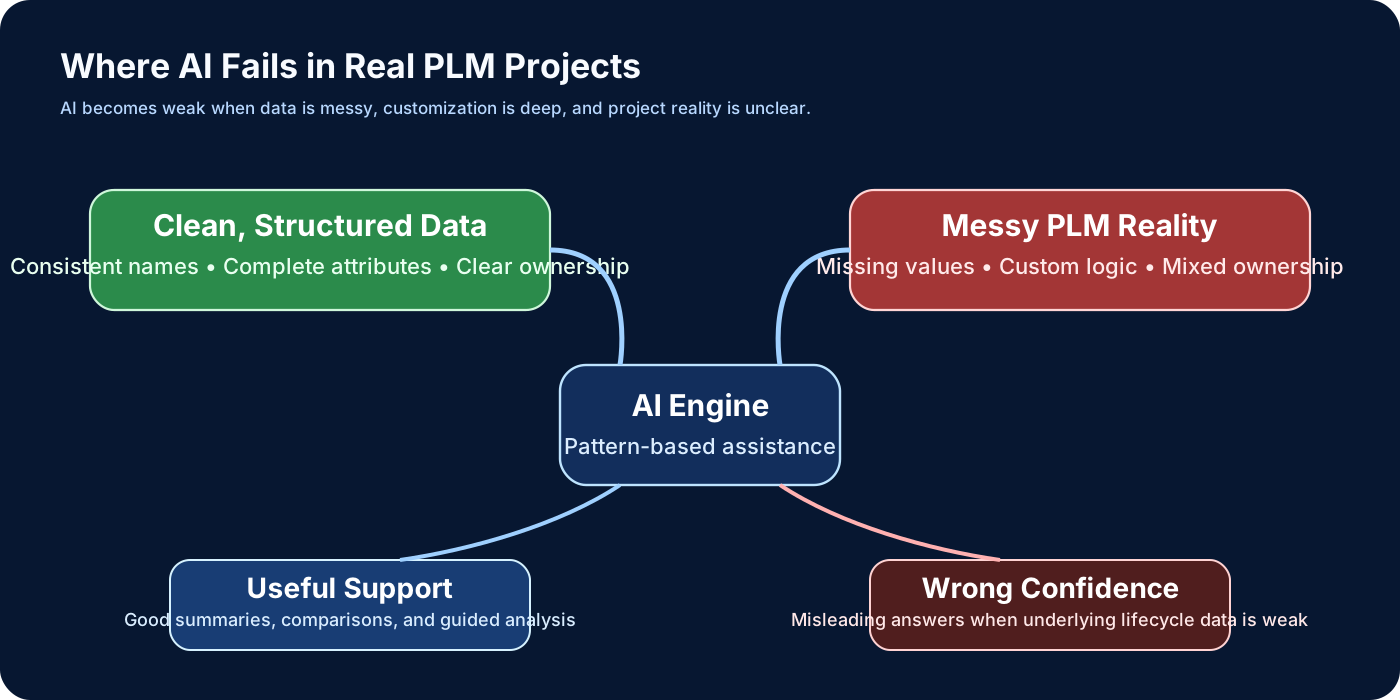
If supplier information is missing, object naming is inconsistent, or BOM attributes are incomplete, AI cannot magically create trustworthy answers. It will still try to answer, but the answer may be misleading. In PLM, wrong data is worse than no data because it creates false confidence.
AI fails in customized Teamcenter environments
Every company has custom workflows, custom properties, custom object types, and company-specific logic. AI may know generic PLM concepts, but it does not automatically understand your procurement revision, your release model, your exact signoff logic, or your integration behavior. That is why generic AI assistance can be useful but still wrong in real implementation details.
AI fails with ambiguous requirements
In real projects, users say things like “we need flexible BOM,” “we need supplier visibility,” or “we need service traceability.” Those statements sound simple, but they require clarification. Do they mean variant BOM? Configured views? supplier part mapping? serialized maintenance history? AI cannot replace the clarification process that experienced engineers and consultants perform.
AI fails in architecture decisions
AI can suggest options. It cannot own trade-offs. It cannot decide the correct source system between Teamcenter, ERP, MES, and service. It cannot weigh performance, governance, user adoption, custom complexity, and long-term maintainability the way a good architect can.
AI fails in integration complexity
Integration failures are not just technical. They involve data ownership, sequence timing, process design, and exception handling. AI can help explain interfaces or propose mapping logic. It cannot operate your real production landscape or solve cross-system accountability issues by itself.
AI fails in production incidents
When a workflow is stuck, data replication fails, or a critical object relationship is wrong in production, AI cannot step in as the accountable owner. It cannot read your full production context automatically, and it cannot take responsibility for the result. It may assist. It does not replace incident ownership.
AI fails in organizational complexity
PLM projects are not only technical. Engineering, manufacturing, service, IT, suppliers, and management all want different things. Priorities conflict. Timelines change. Ownership is unclear. AI cannot negotiate between stakeholders or handle the political side of transformation.
So what should engineers learn from this?
Use AI, but do not worship it. It is strong where work is repetitive, structured, and document-heavy. It is weak where business context, architecture, ownership, and decision-making matter most. This is exactly why strong PLM engineers remain valuable.
Final thought
AI fails where real engineering thinking begins. That is not a weakness of AI alone. That is a reminder that PLM is not only about tools. It is about lifecycle understanding, trade-offs, and responsibility.
👉 Next: Future-Proof Teamcenter Developer →
Continue your learning